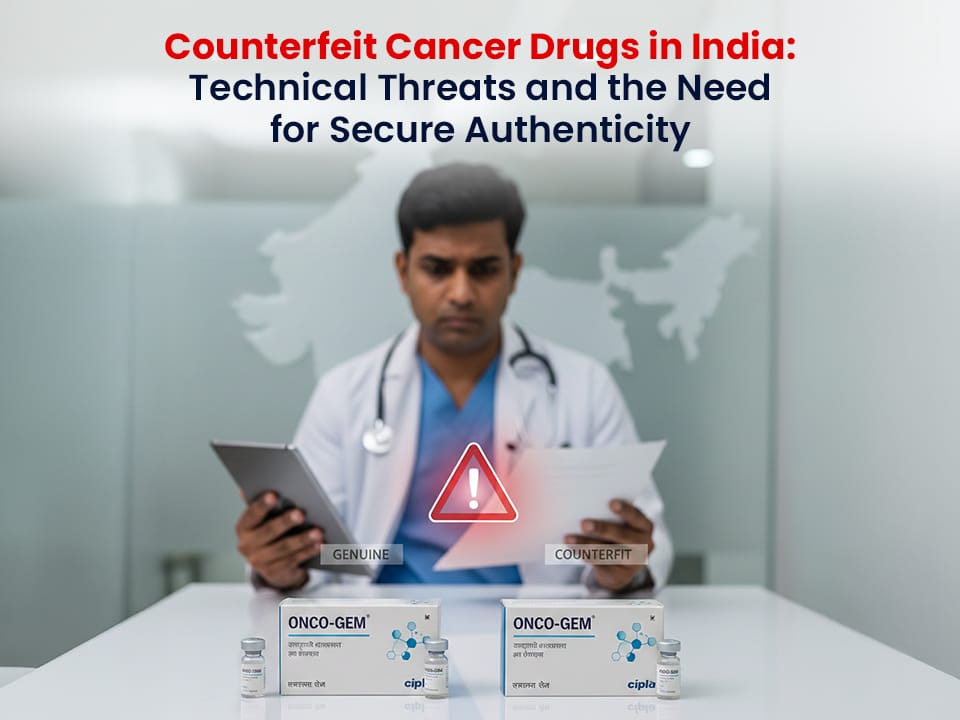
Counterfeit cancer drugs are among the most dangerous forms of pharmaceutical crime, and India faces an alarming rise in these threats. As one of the world’s largest producers of genuine medicines, the country has simultaneously become a high-value target for sophisticated counterfeit networks. With the government mandating QR codes on more than 300 widely used pharmaceutical brands, an important question emerges: Is this step enough to guarantee the authenticity of life-saving cancer medicines?
From an anti-counterfeiting expert’s perspective, the answer is no. While QR codes improve access to product information, they do not automatically ensure authenticity. In today’s counterfeit ecosystem, criminals are fully capable of copying visible security features unless those features are designed to be physically non-replicable.
The Real Scale of India’s Counterfeit Cancer Drug Problem
The threat is not hypothetical. The World Health Organization estimates that 1 in 10 medical products in low- and middle-income countries are falsified or substandard. In India, industry assessments suggest that 10–20% of pharmaceutical products may be counterfeit, depending on supply conditions and geography. Cancer drugs, vaccines, and critical antibiotics remain the most frequently targeted.
The danger is amplified because:
- Fake cancer drugs may contain incorrect dosages
- Some contain toxic or inactive ingredients
- Many have no active pharmaceutical compound at all
- Counterfeiters frequently reuse original packaging and place cloned QR codes on fake products
Even highly trained pharmacists and hospitals can struggle to visually differentiate genuine cancer drugs from high-grade counterfeits.
Why QR Codes Alone Do Not Guarantee Authenticity
India’s QR code mandate is an important regulatory move. These codes display batch numbers, manufacturer names, expiry dates, and product IDs. However, from a security standpoint, a standard QR code is only an information carrier, not an authenticity certificate.
A normal QR code can be:
- Copied using a smartphone
- Reprinted on fake blister packs
- Placed on reused original packaging
- Scanned successfully even on counterfeit products
Since most QR systems only verify whether the data exists in a database—not whether the physical object itself is genuine—they fail to block cloned packaging. In short, QR codes verify information, not originality.
This gap is exactly what counterfeiters exploit.
What True Product Authenticity Actually Requires
Authenticity means proving—beyond doubt—that this physical medicine pack is original and cannot exist in duplicate form. To achieve that level of protection, the pharmaceutical industry must move toward copy-proof authentication technologies, not just visible digital codes.
True authenticity systems require:
1. Physically Non-Clonable Markers
Unlike printed QR codes, physically unclonable features are created using random micro-structures that cannot be replicated—even by the manufacturer. These markers generate a unique “fingerprint” for every single product.
2. Tamper-Evident Label Protection
Authentication loses value if the security label can be peeled and reused. Tamper-evident layers ensure that once removed, the label destroys itself visibly.
3. One-Time Verification Logic
Once an item is verified as genuine, any future attempt to authenticate the same identity again should immediately trigger a warning—signaling possible duplication.
Together, these elements prevent the two biggest weaknesses of QR-only systems: cloning and reuse.
How Advanced Authentication Prevents Counterfeit Cancer Drugs
In a real-world scenario, a patient or pharmacist scans a cancer drug at the point of purchase. If that product uses a copy-proof physical identity instead of a printable QR, the system validates:
- Whether the physical fingerprint matches the stored original
- Whether the label has been previously authenticated
- Whether any tampering attempt has occurred
If counterfeiters attempt to duplicate the label, the system instantly detects that the physical identity does not match the original. This is the only reliable way to stop package-level cloning, which remains the most common method used in fake cancer medicines today.
Where Checko Fits In the Authenticity Ecosystem
Checko operates in the physical product authentication space and specializes in 3D PUF (Physically Unclonable Function) labels—a technology that ensures each product has a naturally unique, non-replicable identity. Unlike QR codes, 3D PUF labels cannot be photographed, copied, printed, or mass-duplicated.
Each label’s microscopic randomness functions like a biometric signature for products, enabling absolute proof of originality. While Checko does not serve the pharmaceutical sector directly, the same core principles of copy-proof authentication, tamper resistance, and physical uniqueness are exactly what the pharmaceutical industry requires to prevent counterfeit cancer drugs.