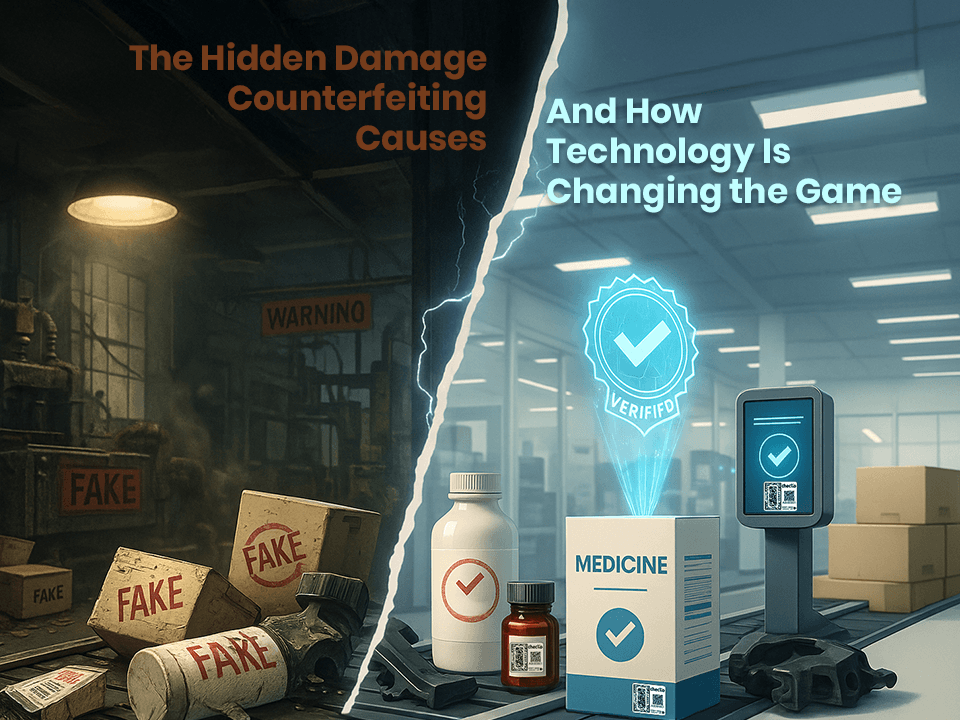
Counterfeiting isn’t just a trademark issue anymore — it’s a business continuity challenge. From luxury goods to automotive components, counterfeit infiltration impacts brand reputation, operational revenue, and consumer trust.
The Ripple Effects of Counterfeit Goods
1. Brand Reputation Degradation
When fake products fail, customers rarely blame the counterfeiter — they blame the brand name on the label. The result? Trust erosion that can take years and millions in marketing spend to rebuild.
2. Financial Leakage
Counterfeiters exploit the innovation and marketing investments of genuine manufacturers. Every fake product sold represents lost revenue, stolen market share, and diminished R&D potential.
3. Safety & Liability Risks
In sectors like pharmaceuticals, automotive, and electronics, counterfeit goods can have catastrophic consequences. Beyond safety failures, brands face lawsuits, recalls, and permanent loss of credibility.
4. Consumer Confidence Collapse
Once a customer unknowingly buys a fake, they rarely return to the brand. That single experience can ripple across social media, discouraging other potential buyers.
5. Legal & IP Complexities
Protecting intellectual property against counterfeiters demands constant enforcement and monitoring — a costly, ongoing battle that distracts from core business growth.
6. Economic Fallout
Counterfeiting undermines fair competition, stifles innovation, and drains tax revenues that sustain national economies. Its ripple effect extends far beyond individual brands.
The New Era of Authentication
As counterfeit networks become more sophisticated, traditional defenses — holograms, barcodes, and QR codes — no longer suffice. The industry is now moving toward unclonable physical-digital identifiers that merge material science with secure data systems.
One such advancement is the 3D Unclonable Label — a tamper-proof marker that integrates physical microstructures with encrypted digital identity. These labels cannot be copied or reprinted, creating a one-to-one link between a physical product and its verified digital twin.
How Checko Is Enabling This Transition
Checko’s 3D Label technology brings this vision into practice. Each product is embedded with a unique 3D physical pattern — impossible to duplicate — and linked to a secure digital record in the Checko cloud infrastructure.
When scanned through the Checko App, the label’s physical and digital signatures are verified in real-time. If duplication or anomaly is detected, the system immediately flags it.
Each scan event captures location and timestamp data, enabling brands to visualize counterfeit hotspots, trace supply chain leaks, and build intelligence-driven anti-counterfeit strategies.
At the same time, this technology opens up new possibilities — warranty activation, consumer engagement, and behavior analytics — helping businesses turn product verification into an opportunity to build trust and loyalty.
Beyond Protection: Building a Data-Driven Brand Integrity Framework
The fight against counterfeiting is no longer about defense. It’s about leveraging technology to transform protection into insight. By integrating unclonable identifiers, real-time data, and customer interaction, brands can finally regain control of their product’s journey — from factory to consumer.
Counterfeiting may be inevitable. Losing trust doesn’t have to be.